Idea Check:
See Where Your Research Idea Sits in the Field
CSPaper
A part of Scholar7 AB · May 2026
TL;DR
Idea Check maps your research idea against the recent literature so you can see where it sits before you commit months to it.
Paste an idea, an abstract, or a rough draft. In a couple of minutes you get the closest accepted papers from top CS venues, scored and explained, a read of what the field looks like, and the open gaps worth chasing.
It is a map, not a verdict. You still decide what to build.
You have an idea you are excited about.
And then the small, cold voice: hasn't someone already done this?

The question every idea starts with
Every research idea begins with the same nagging question: has this already been done? The honest way to answer it is to read the field, but the field is enormous and grows every week. So we tend to skim a few familiar papers, half-convince ourselves the idea is new, and start building, only to meet the paper we should have read in Reviewer 2's comments months later.
Idea Check closes that gap. It takes your idea and shows you, in a couple of minutes, where it sits in the published landscape: what is closest, what makes each neighbor different, and where the open space is.
What Idea Check is
Paste a research idea, an abstract, or a rough draft. Idea Check compares it against 110,000+ accepted papers from top CS venues (NeurIPS, ICML, ICLR, ACL, EMNLP, CVPR, and more, and the index keeps growing) and returns a structured read of the field rather than a list of links.
There are three parts to what you get back:
- Where your idea sits — a plain-language positioning of your idea against the closest work.
- What the field looks like — a synthesis of the dominant themes, the range of methods, and a confidence level.
- The closest related papers — scored and explained one by one, plus the gaps the literature leaves open.
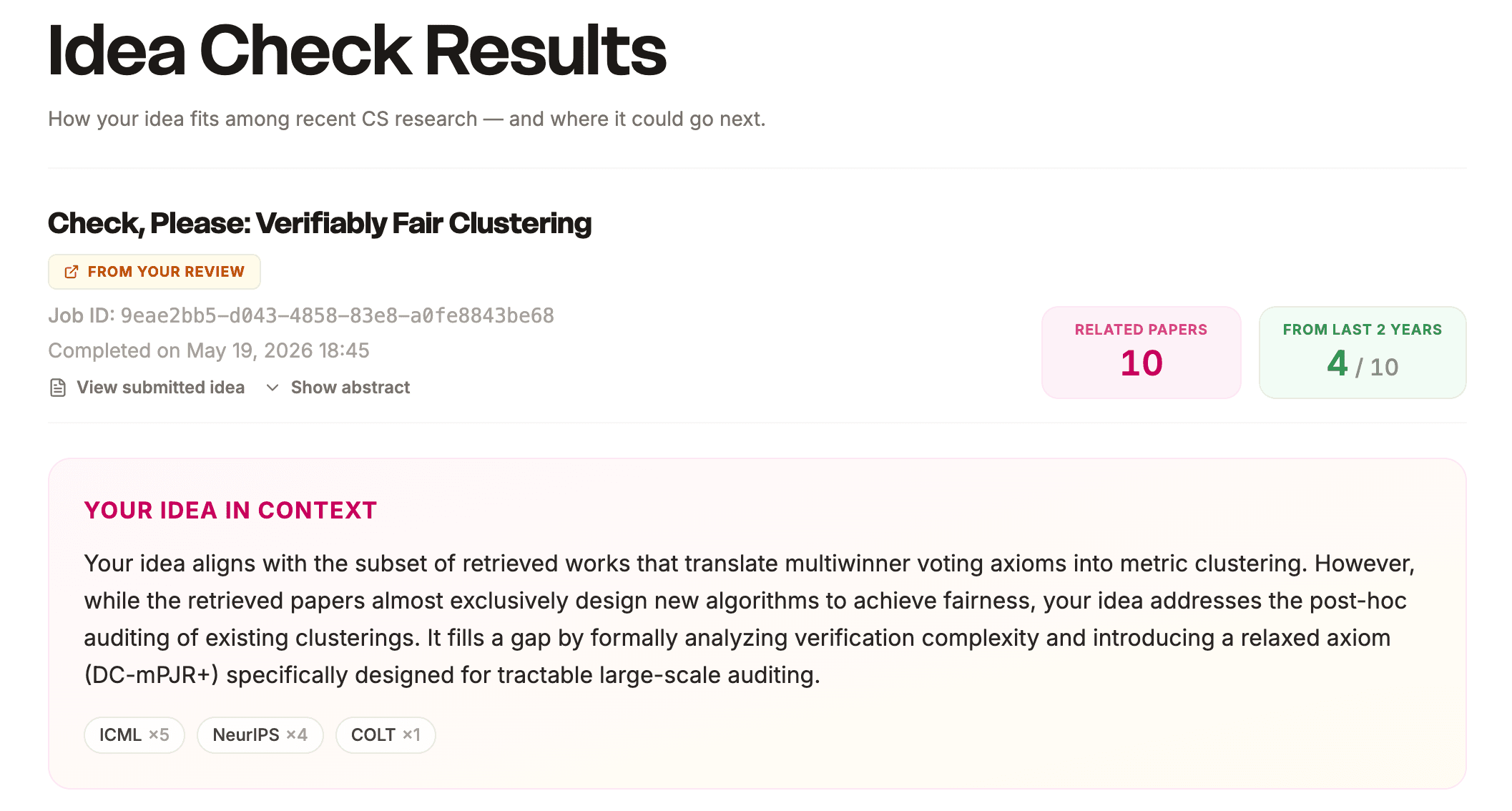
To make this concrete, the screenshots below come from a real check on a paper titled "Check, Please: Verifiably Fair Clustering", run straight from its CSPaper review.
Where your idea sits
The result opens with one short paragraph that does the thing you actually wanted: it tells you how your idea relates to the papers it found, and what sets it apart. For the example, it noted that the idea sits with the works translating multiwinner voting axioms into metric clustering, but distinguishes itself by auditing existing clusterings after the fact rather than designing yet another fair algorithm, filling a gap others had not formally addressed. Above it sits a quick venue breakdown (ICML ×5, NeurIPS ×4, COLT ×1) and how many matches are recent.
What the field looks like
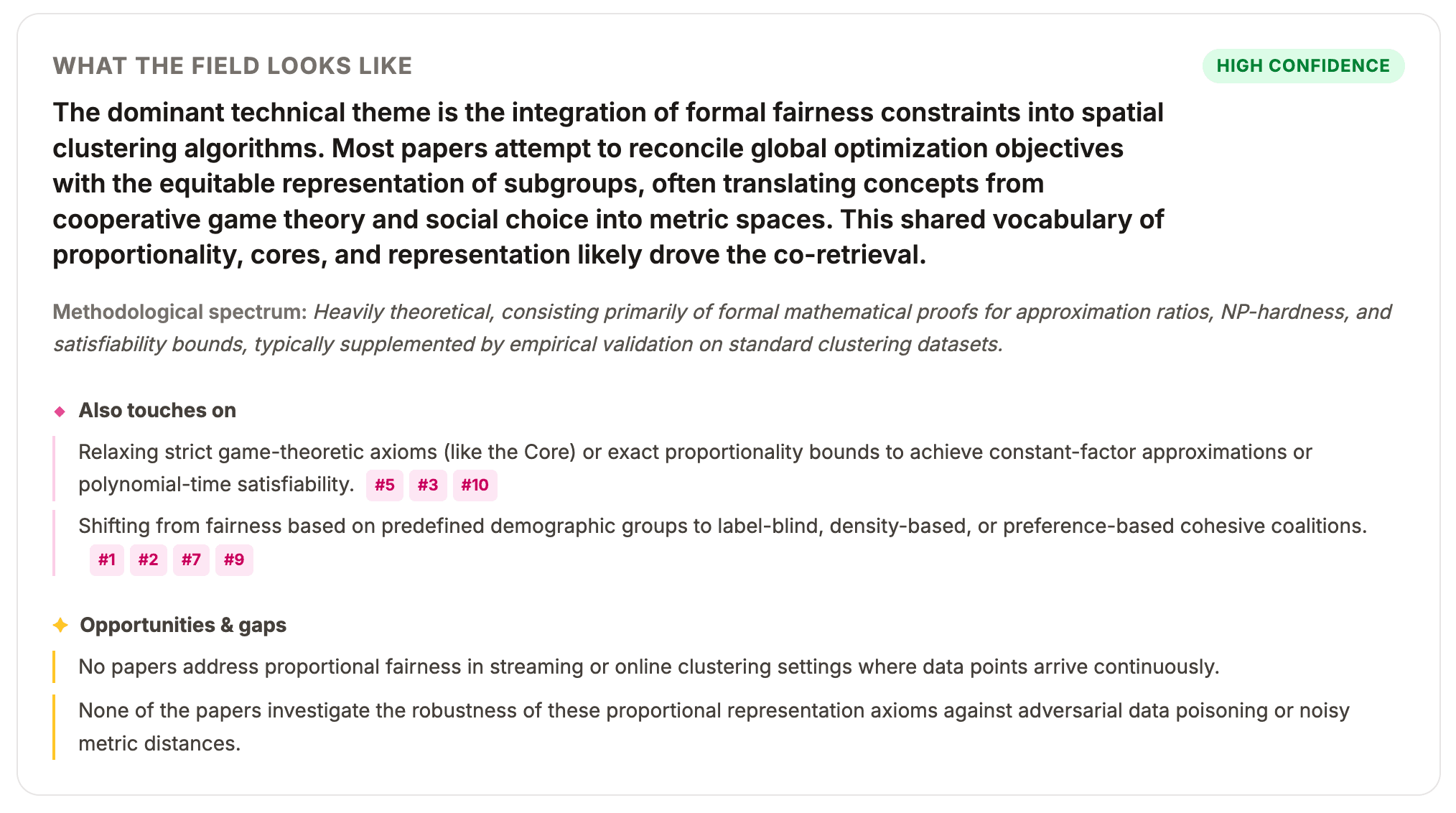
Next comes a synthesis across all the matches, carrying a confidence level (high, medium, or low) so you know how much weight to give it. It names the dominant theme, sketches the methodological spectrum (in the example: heavily theoretical, mostly formal proofs of approximation ratios and hardness bounds, with empirical validation on standard datasets), and lists the secondary patterns it noticed, each linked back to the specific papers that show it.
Related work, scored and explained
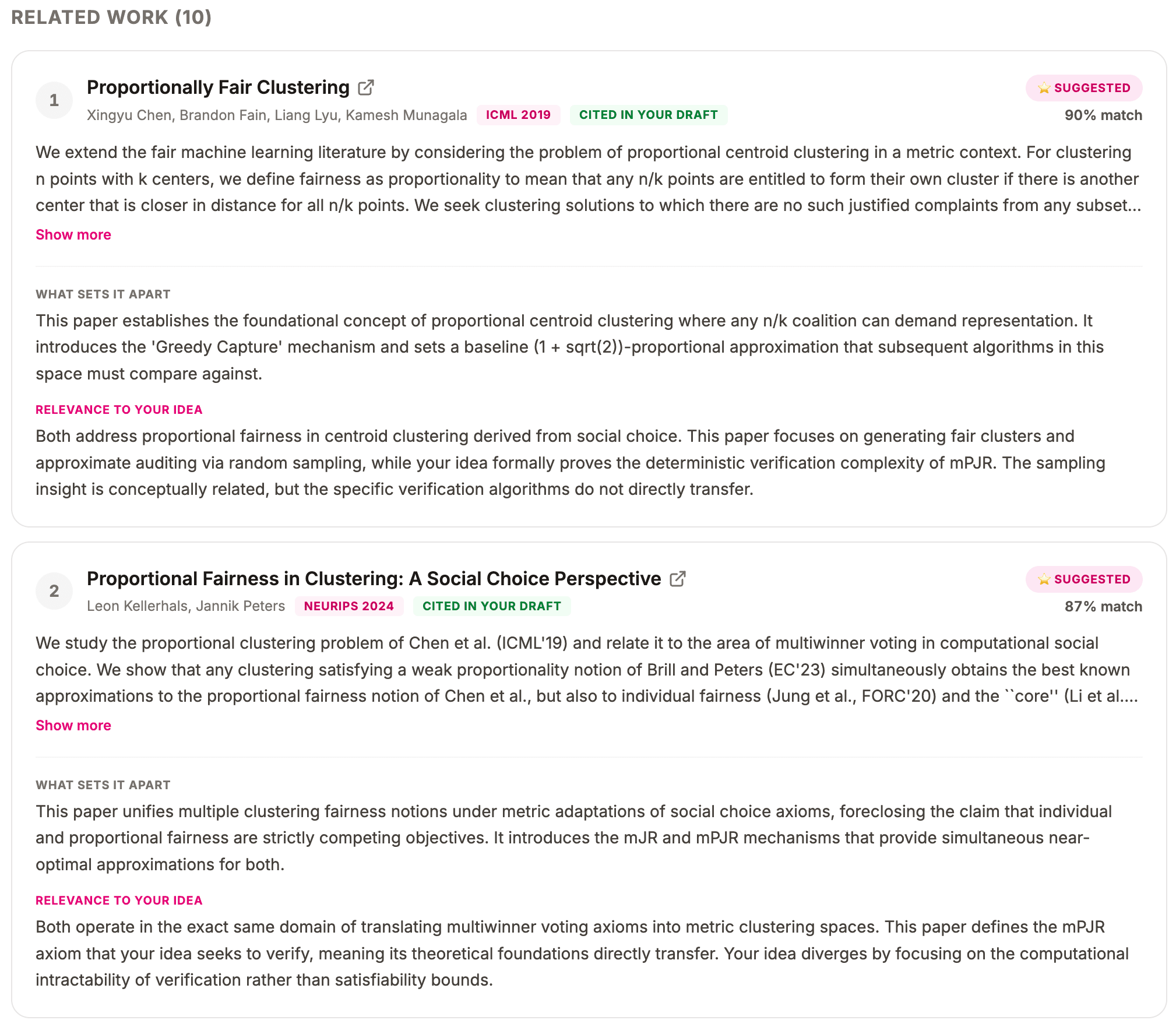
Then the papers themselves, ranked by how closely they match and labelled so you can triage at a glance: ⭐ Suggested for the strongest matches, 🔍 Worth a look for the solid ones, and Tangential for the rest, each with a percentage.
What makes each card useful is the two lines a raw search never gives you: What sets it apart (the paper's own distinct contribution) and Relevance to your idea (exactly where it overlaps with yours, and where it diverges). In the example, the top match, Proportionally Fair Clustering (ICML 2019, 90%), was named as the foundation the idea builds on, with a note that its sampling-based auditing is only conceptually related to the idea's deterministic verification. Papers you already cite carry a Cited in your draft badge, so the uncited ones near the top are exactly the prior work you may have missed.
Where it could go next
The part most authors screenshot is the opportunities and gaps: a short list of things the retrieved literature does not cover. For the example, it pointed out that no retrieved paper handled streaming or online clustering where data arrives continuously, and none tested these fairness axioms against adversarial poisoning or noisy distances. These are not instructions. They are leads, the white space around your idea made visible, so you can decide where to plant your flag.
Two ways to run it
Idea Check meets you wherever the idea is:
- From a fresh idea. Open the Idea Check page and paste an abstract, a paragraph, or a rough draft, any phase of writing.
- From a completed review. Already had a paper reviewed on CSPaper? Open the review, switch to the Idea tab, and run a check on that paper directly, which is exactly how the example in this article was produced. Each review can be checked once.
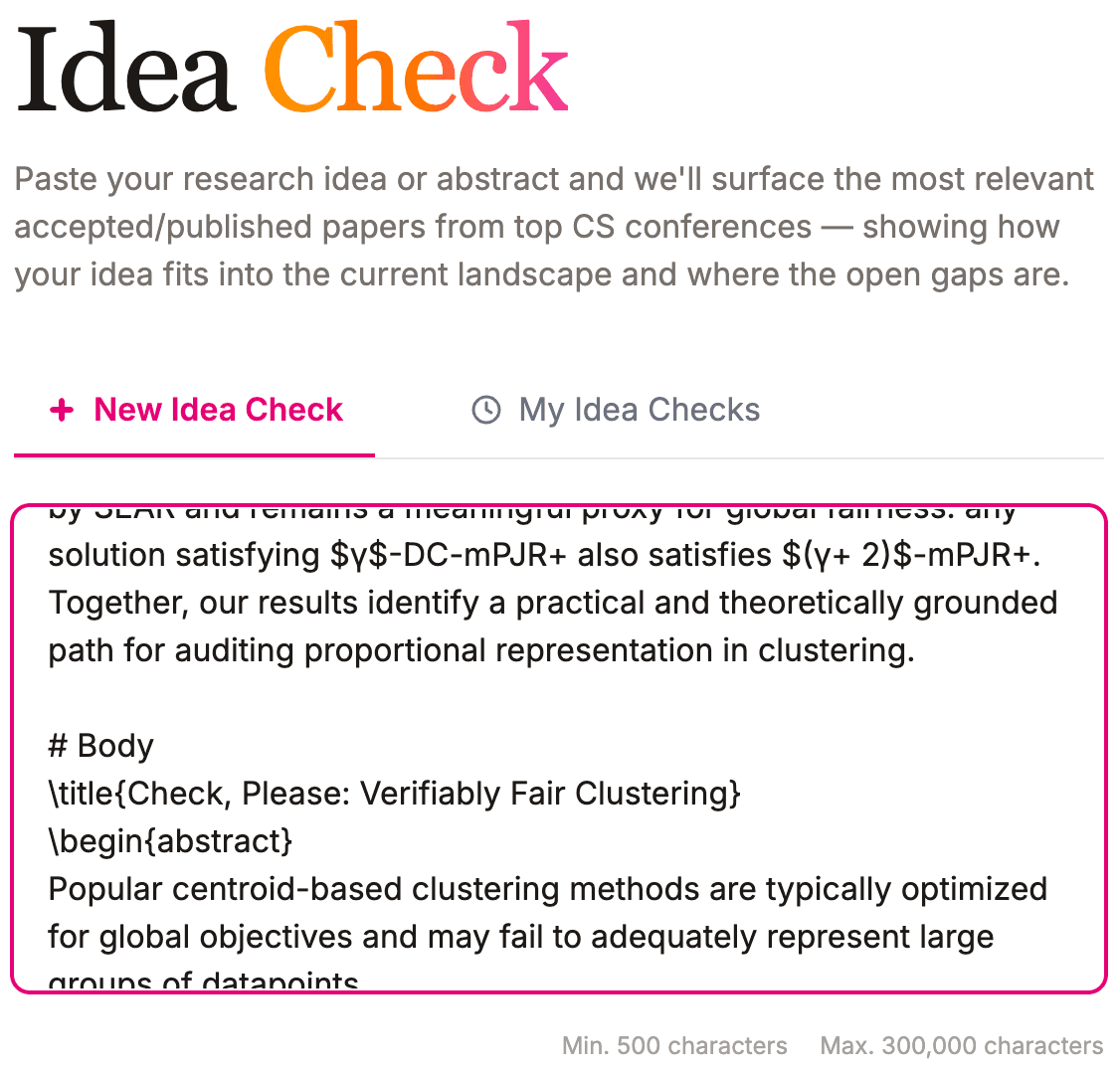
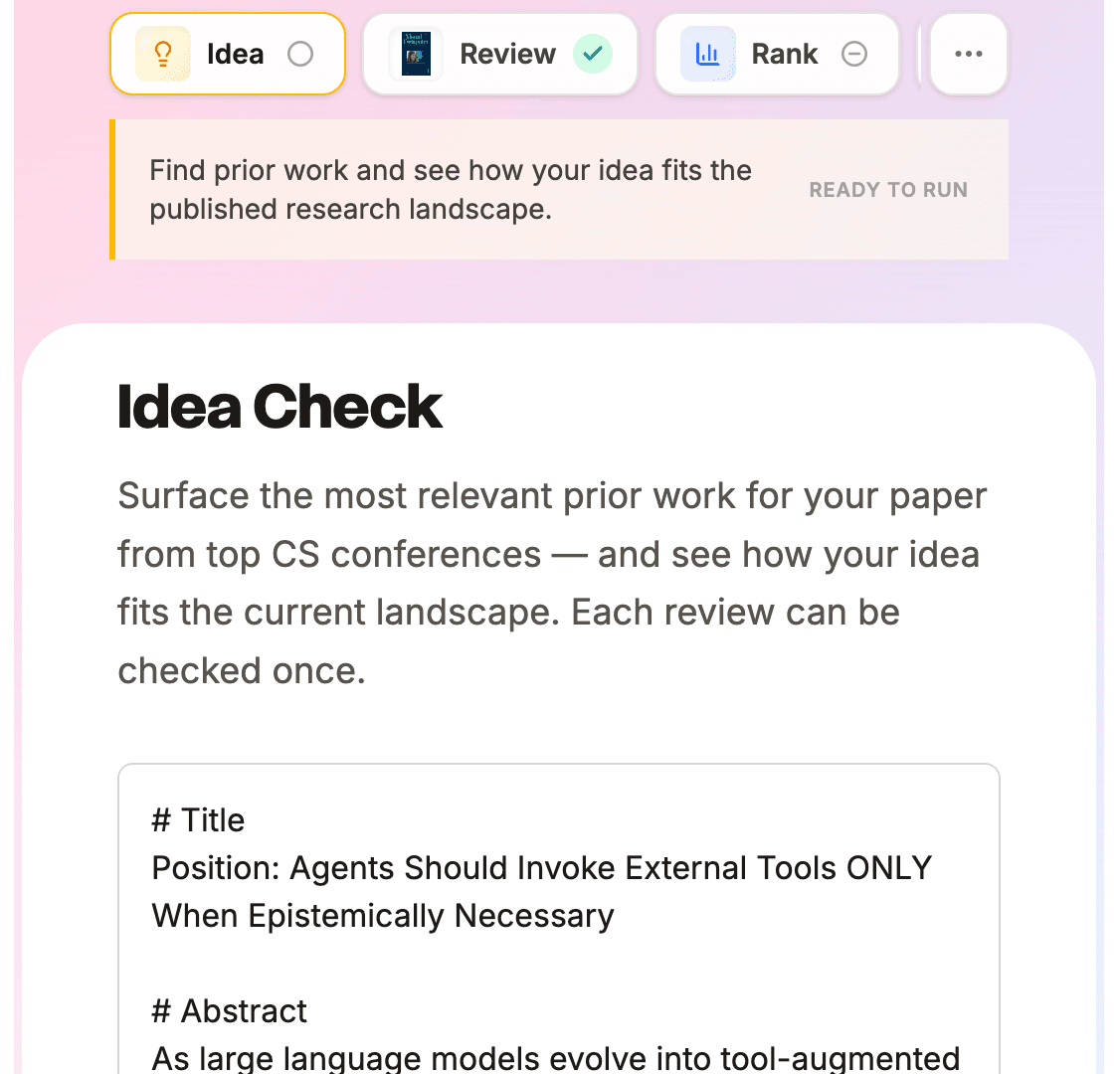
Either way the result is the same map: context, field, related work, and gaps.
Good to know
- It checks the input first. A quick pre-analysis reads what you pasted. If it is not actually a research idea, a bare topic word, a question, or an off-topic paste, it says so in plain language and does not spend a credit.
- Scope is computer science. The index covers major CS conferences, so it is sharpest on CS research.
- The first three checks are free, no credit card. After that each check is one credit, refunded automatically if a run fails to produce a usable result.
- It is a map, not a verdict. Idea Check shows you the landscape; it does not score your idea or predict acceptance. The judgment stays yours.
Try Idea Check
Next time that cold little voice asks whether your idea is new, give it a real answer. Paste the idea, read the map, and start building from a position you can defend.
Not a verdict on whether your idea is good enough,
but a clear view of the ground it stands on.
Idea Check is built in partnership with priorwork.fyi.