Platform APIs:
Verification Infrastructure for Your Pipeline
CSPaper
A part of Scholar7 AB · July 2026
TL;DR
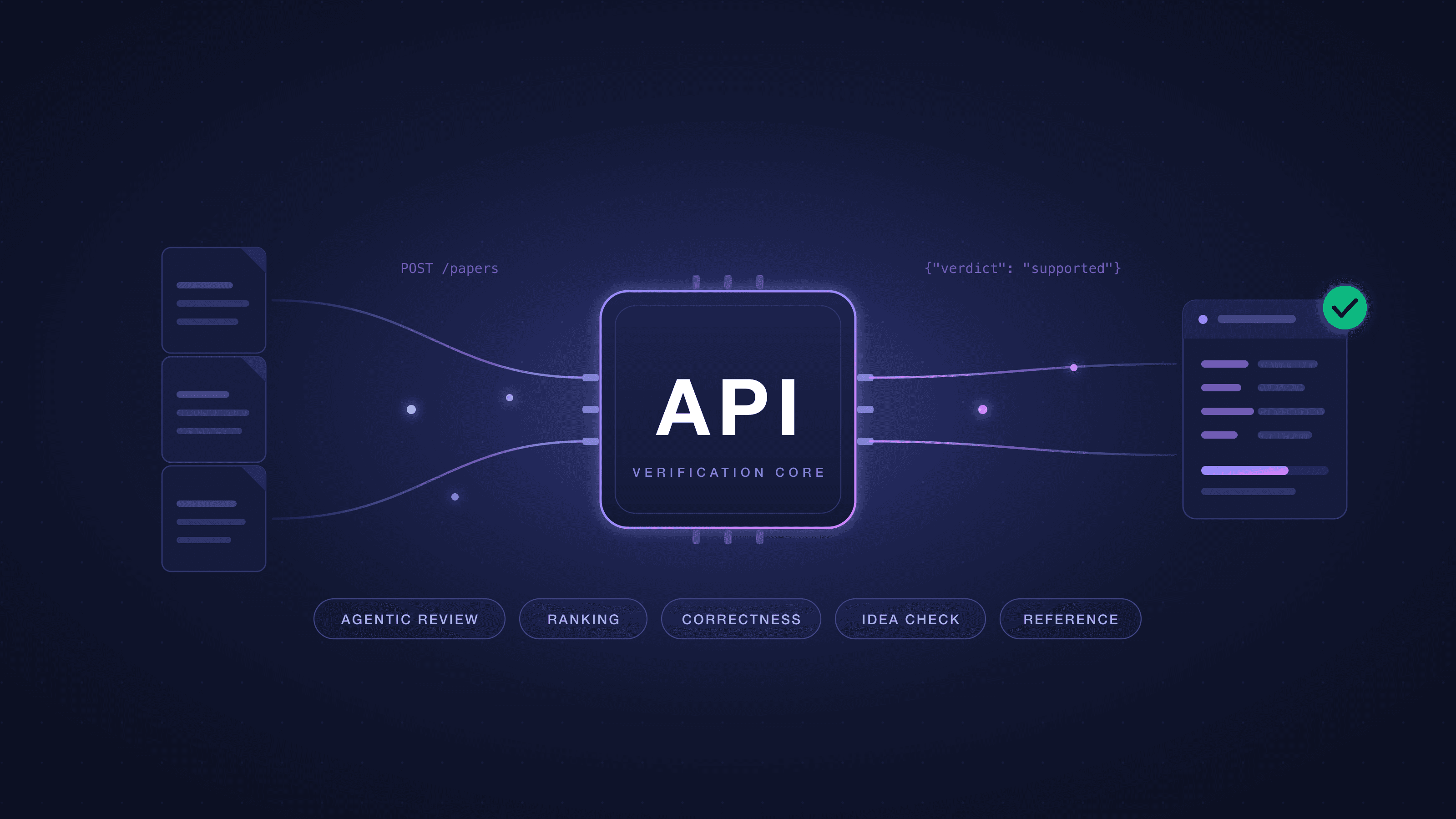
- The verification stack behind CSPaper (agentic review, paper ranking, correctness check, idea check, and reference check) is now callable directly through the Scholar7 Partner Platform APIs.
- It is built for anyone running research at volume: publishers and venues, research labs and companies, and individual researchers or small teams with substantial throughput.
- Getting started is a conversation, not a checkout: we set up your platform account and API keys, then invoice monthly based on usage.
- Pricing is scoped to your estimated volume, at a rate below the consumer tier.
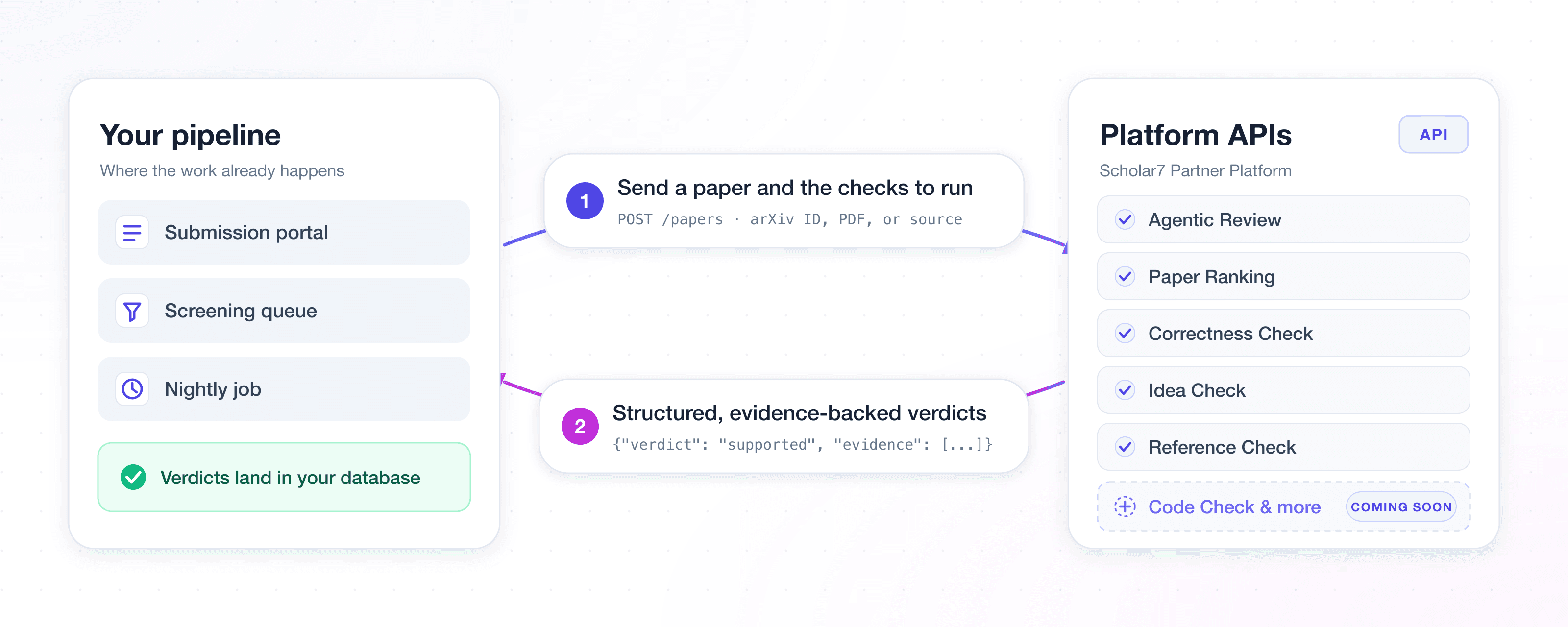
Verification is most useful when it runs where the work already happens: inside a submission system, a lab's screening queue, or a nightly pipeline. Not in a browser tab someone has to remember to open.
That is why we opened it up. Everything CSPaper does in the app, you can now do with an API call.
What the Platform APIs are
The Platform APIs are the programmatic entry point to CSPaper's verification stack, delivered through the Scholar7 Partner Platform. Every capability you can run by hand in the app, whether a deep agentic review, a calibrated ranking, a correctness check, an idea check, or a reference check, is available as a stable, authenticated endpoint you can call from your own systems.
Concretely, that means: submit a paper (arXiv ID, PDF, or your own source), pick the checks you want, and receive structured, evidence-backed results you can store, route, and display inside your product. No copy-paste, no manual uploads, no one babysitting a queue. Access is scoped to your organization by API key, and everything you spend shows up on your usage dashboard.
The app is the storefront. The APIs are the same engine, wired straight into your pipeline.
Why we offer APIs
We have argued for a while that peer review at today's volume survives only if AI produces verifiable evidence rather than confident prose. That belief only pays off if the verification runs at the point of decision, and an API is how it gets there. The reasons are the ordinary ones that make any capability more valuable as an endpoint than as a web page:
Run thousands of submissions through the same checks without thousands of clicks. Batch a whole conference cycle or a quarter of lab output overnight.
Verification lands inside the tools people already use: a submission portal, an internal dashboard, a CI job. Nobody has to leave their workflow and come back.
Trigger checks on an event, such as a new submission, a revised draft, or a nightly sweep, and route the results by rule. No human has to remember to press start.
Structured, machine-readable output you can persist, filter, and combine with your own signals. Verification becomes a first-class field in your data, not a screenshot.
Who it is for
When we launched the platform we were thinking about publishers. We still are. But the people asking for keys turned out to be a broader crowd than that, and we have leaned into it.
Publishers and venues
This is where a verification-first workflow changes the economics of review most directly. A soundness check, a ranking signal, or a reference audit attached to every submission gives editors and reviewers a grounded starting point and routes human attention to the papers that need it. It is not a hypothetical: a leading ML journal ran an independent evaluation of four AI reviewers on real submissions and planted-error papers, and selected CSPaper's review agent for its soundness pilot. That pilot is deployed through exactly these APIs. If you run a venue, that is what integration looks like in practice.
Research labs, companies, and organizations
Increasingly, the teams reaching out are not publishers at all. Research labs and R&D organizations use the same checks internally: to sift a firehose of preprints for what is worth reading, to pressure-test their own manuscripts before submission, to audit references and claims across a body of work, or to keep an internal bar for what leaves the group. The APIs let that verification run quietly against a private corpus, on your schedule, inside your own tooling. No paper ever has to pass through a public workflow.
Individual researchers and small teams
You do not have to be an institution. If you are an independent researcher or a small team running a substantial volume, say a systematic review, a large reading list, or a steady stream of drafts, you are welcome to use the APIs too. The consumer app is there for one-off runs; the platform is there when your volume outgrows clicking.
What you can call
Every pillar of the platform is an endpoint. Mix and match the ones you need: run a full review, just a reference audit, or ranking on its own.
A deep, evidence-grounded review of a paper, configurable to a venue's rubric and format. The same agent behind our external review pilots.
Calibrated scores and percentile standing relative to other papers reviewed by the same agent, so you get a comparable signal instead of an isolated number.
Claim verification and objective-error discovery, surfacing where a paper's core claims are and are not supported by its own evidence.
Prior-art discovery against a large corpus of accepted papers: closest related work, confidence-scored matches, and where an idea sits in the field.
Automated citation-integrity verification that flags references that misattribute, do not exist, or do not support the claim they are cited for.
Paper-code alignment auditing: does a paper's repository implement what the paper claims? Available in the app today and documented here; API access is on the way.
Need the whole pipeline rather than a single check? A turnkey setup wires these together to power an end-to-end publishing or screening workflow. Tell us what you run and we will scope it with you.
How it works
Onboarding is deliberately human. Because usage is billed and often tuned to a venue's rubric or a lab's corpus, we set every organization up by hand rather than behind a checkout button.
Any organization that wants to use the APIs contacts us first. Tell us what you want to run, roughly how much, and any venue or rubric specifics.
We provision your platform account and issue API keys scoped to your organization. You manage them and watch consumption from the usage dashboard.
Integrate the endpoints into your submission system, dashboard, or pipeline and start sending papers. You do not have to start from a blank file: our open-source platform-examples repository has working scripts for submitting papers in batch and collecting results. Everything comes back structured and ready to store or display.
We invoice each month based on what you actually used. No upfront seat licenses and no surprise metering: the usage dashboard always reflects what the invoice will say.
Pricing
Pricing is based on your estimated volume, at a rate below the consumer tier. The more you run, the better the per-check economics, which is the whole point of moving verification into a pipeline. We scope it with you up front so the monthly invoice holds no surprises.
Get started
If you run a venue, a lab, a company, or simply a high-volume research workflow and want verification wired into it, we would love to hear what you are building. Reach out and we will get you set up. And if you prefer to see real code before you write to us, browse the examples on GitHub first.