
Abstract
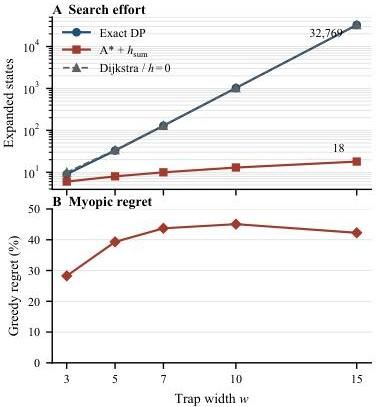
When a student must learn concepts connected by prerequisite dependencies, when does the order of instruction matter, and what does it cost to find the best one? We study instructional sequencing as a stochastic shortest-path problem in which attempting a concept succeeds with a state-dependent probability and failure leaves the learner state unchanged. We first prove that this stochasticity can be eliminated exactly: the problem collapses to a deterministic shortest-path problem on the lattice of prerequisite order ideals, preserving optimal values and actions. The collapse removes stochastic complexity but not combinatorial complexity: optimal sequencing remains NP-hard—via reduction from feedback arc set in tournaments—even with no prerequisite edges, unit costs, uniform binary nonnegative transfer, and success probabilities at least 1/2. Hardness is not uniform: when realizable transfer preferences remain jointly acyclic with the prerequisites, any topological order of the residual joint graph is optimal, and fixed prerequisite width yields polynomial-time exact dynamic programming. A computable diagnostic, mΔ, bounds the value of sequencing before optimization. On 70,893 interactions from an introductory CS course, the diagnostic certifies a doubly easy regime—little value to optimize and little space to search—while constructed transfer instances realize the challenging regime, where myopic sequencing suffers large regret yet exact A* with a consistent heuristic expands only linearly many states on that family.
Keywords
Illustration
Citation
@article{Han2026Stochasticity,
  title={Stochasticity Is Not the Hard Part: Reduction and Complexity in Instructional Sequencing Over Prerequisite DAGs},
  author={Zonglin Han and Yichen Chen and Jiawen Jiang and Tongan Shi and Kristian A. Stevens},
  year={2026},
  url={https://cspaper.org/openprint/20260805.0006v1},
  journal={OpenPrint:20260805.0006v1}
}Version History
| Version | Released Date | Submitter |
|---|---|---|
v1Current | Aug 5, 2026 | Zonglin Han |